

Progress not perfection
Relearning an old lesson. Again.

I thought I would have learned this one by now. But it turns out, I haven’t.
I’ve been paralysed by perfectionism. Again.
Not just perfectionism, but guilt. Guilt born of the weight of expectations.
In June this year I published an article entitled ‘Does LinkedIn have a problem with female founders?’. I published it here, on This Women’s Work’s own site and on LinkedIn.
To my surprise, it resonated beyond my immediate network. I got 80 subscribers to This Women’s Work’s page on LinkedIn and I got 125 subscribers to a new LinkedIn newsletter I started.
It even got shared - by someone else - on an outside feminist professional network, the 7th Tribe - exactly the right place to connect with my ‘ideal’ audience.
Yippee! I thought. Yippee! This idea I’ve had in the back of my mind for the past four years resonates! Other people care about what I care about! Other people care about:
how men and women get treated differently in the workplace
why that makes zero economic sense
why that makes zero moral sense (although it should be frickin’ obvious)
why women get held back
how to fix things so men and women get a fair, level playing field.
Most importantly, I thought, it showed that other people also wanted to see things change - and they felt my words could help bring about that change.
Following the feedback
I immediately felt like the feedback had something important to tell me, which was:
‘Keep writing - but keep writing about this.
Keep it about professional women.
Keep it about the LinkedIn algorithm.
Keep going, but keep going in this direction’.
That was fine. I had already planned to explore whether gendered or unconscious biases were playing a part in the silencing of female founders. My follow-up article, Stereotypes at Scale, continued the theme.
Suddenly my LinkedIn newsletter jumped to 250 subscribers. I felt like I was contributing to a wider cause - one that luminaries of diversity, equity and inclusion such as Cindy Gallop, Jane Evans and Jeremy Stockdale were contributors to, too.
I’m not going to lie to you - it felt like I was arriving. The risk of sticking my head above the parapet felt like it was paying off. All the time planning, strategising, and (again I’m not going to lie) feeling frustrated doing the ‘women’s work’ of caring for my two babies when I wanted to do the ‘real work’ of changing the world for them suddenly felt… validated.
I have passionately felt that diversity, equity and inclusion are business imperatives as well as moral imperatives for as long as I have been working. My own experience of becoming a mother as a senior professional woman cemented it. I have wanted to contribute to the beleaguered field of diversity, equity and inclusion ever since.
So to have this validation and ‘feedback’ felt - honestly - like destiny.
And then an amazing, brave mother called Jessica wrote an impassioned LinkedIn post about her search for work. How she’d been let go from her job as an events manager despite delivering incredible results. How she’d struggled to find something that made use of her skills but worked around her young family.
How she’d been insulted on a call to claim her Universal Credit entitlement, when an ‘advisor’ called Mark told her she shouldn’t bother working the few hours she could when her children were so young. That as a mother she should be at home with them. That’s where her real work was.
I was incandescent with rage on her behalf. I reached out and arranged an interview with her, and an interview with an HR consultant to explore why and how this patriarchal bullshit was still being peddled in 2025.
But then guess what happened - I was waylaid by:
summer holidays
family illness (mine and others)
perfectionism.
The problem of pressure
I’ll put the first two in the bucket of ‘women’s work’. And the last one I’ll say is a symptom of being a working woman in this world.
You see, once I’d posted the first two articles I felt something I hadn’t before - pressure.
The pressure to meet others’ expectations. The pressure to perform. The pressure to professionalise.
Professionally, I am a content strategist, writer and copywriter in the professional services space. I have nearly twenty years of digital writing and marketing experience, have worked in two global marketing departments, led a global content team of 16 and won 26 awards over my career.
The burgeoning interest in This Women’s Work over on LinkedIn and on here made me think:
I can’t publish another article until I have written the article with Jessica and the HR consultant’s interviews (although when I was going to have time for that over the summer holidays was anyone’s guess).
Anything I write has to be polished, professional, on-brand, and serious because that’s how I’ve started out, and that’s how I want my professional brand to look (even if the truth is I don’t have everything figured out, I’m just a normal human mother trying my best at home and at work; like most normal humans I fall short of my own standards all the time).
I have to keep getting results with my writing otherwise everyone will think I’m a fraud and I won’t be taken seriously by any potential clients out there (and man the economy sucks at the moment so I really want to be taken seriously by any potential clients out there).
What I didn’t realise is all these swirling thoughts came from one source: perfectionism.
Somewhere in my head there’s a ‘perfect’ version of Hazel who can:
get exponential growth every time she posts;
always gets interviews and articles done in a timely manner, despite whatever else is going on at home;
keeps all her interviewees updated and feeling like they’ve been heard and are being looked after (there’s so much guilt I feel for not having published those interviews yet!);
can juggle her professional work, passion project, career growth, house work and mothering work with effortless poise. She’s never tired, she’s never grumpy, she never gets frustrated with her kids, and she’s always productive - no matter what;
oh and she always looks professional, polished and poised too. No matter how little sleep she’s had.
The pressure to be perfect paralysed me. So I didn’t publish anything for four months.
And I didn’t realise how NORMAL that is until I talked to other writers who are on this platform and ‘get it’.
The pressure to write for subscribers, Substack Notes, the LinkedIn algorithm.
The pressure to put on your ‘professional’ writers voice when actually you want to share your real, messy voice.
A further irony in my own story of perfection paralysis is that it happened during a time of severe limited mobility. Last year I had to have emergency spinal surgery after I suffered a herniated disc and squashed sciatic nerve from picking up my toddler awkwardly. I still can’t walk normally and have foot drop in my right foot.
This May, due to the squashed sciatic nerve, I tripped and fell and broke five bones across both my feet. I couldn’t walk so I crawled around at home. Then progressed to a wheelchair. Then progressed to two moon boots. And finally to the foot drop brace I’m slowly beginning to think I’ll be wearing for the rest of my life.
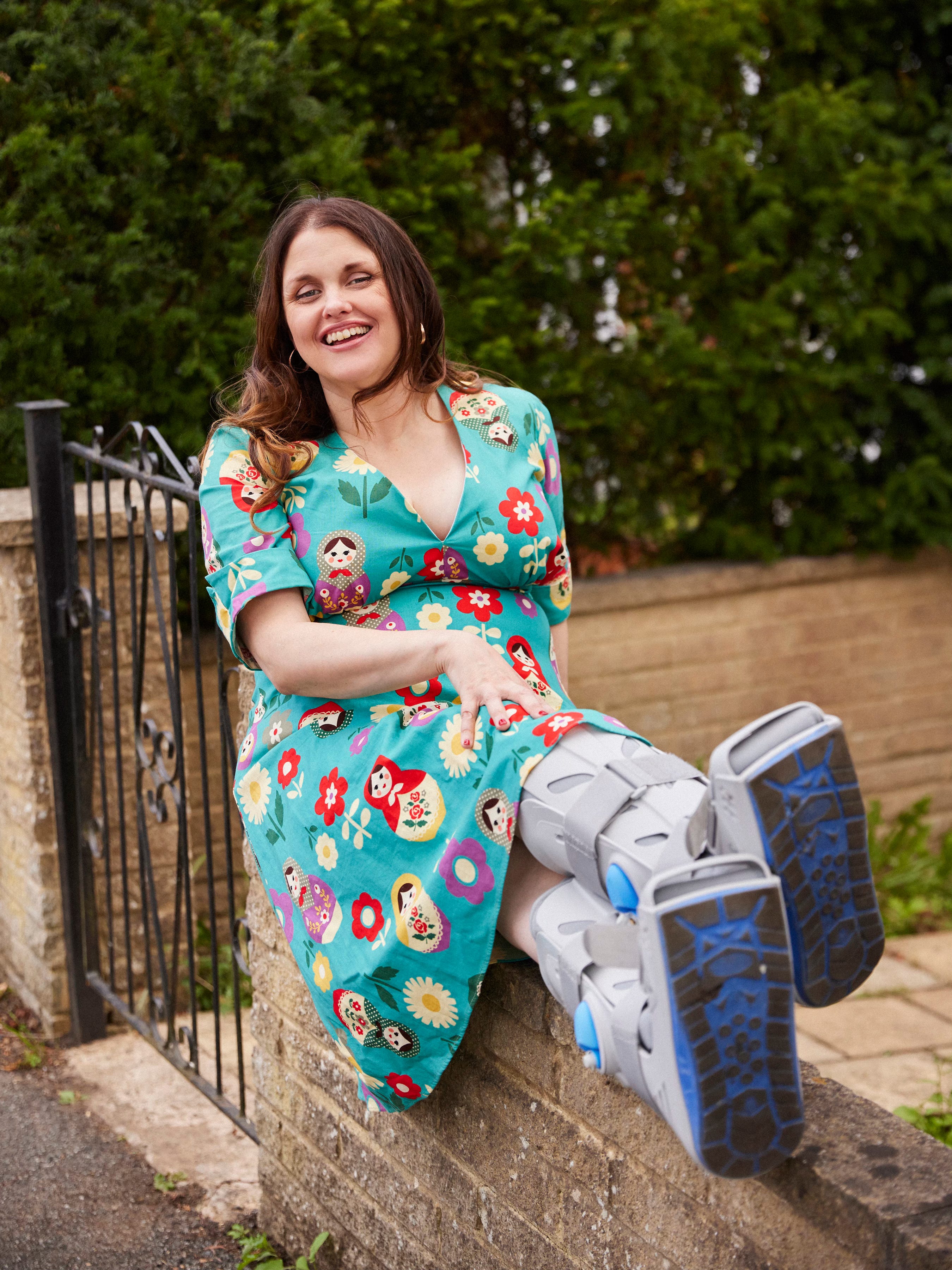
I still did a professional photoshoot with my moon boots on this summer though.
The pressure of perfectionism made me forget something important.
Part of the point of This Women’s Work is to illuminate how women - usually mothers - can’t have it all and can’t do it all.
Because no one can. Our society isn’t set up for the realities of modern working life.
Perfection is either an ideal or an illusion. Neither is real.
What is real?
Progress. No matter how small, fleeting or faltering.
For This Women’s Work, I need to remember how I progressed from no-one knowing about it at all to some people knowing about it. And some people being kind enough to offer kind words about it. Does it need to be more to be ‘worthy’ in this world?
For myself, I need to remember how I progressed from not being able to stand up five months ago, to being in a wheelchair, to walking on two moon boots to now walking with just orthotics and a foot drop brace. I may be losing hope that I will ever walk ‘normally’ again, but at least I am walking. Able to do the school run. Able to get public transport even if I can’t drive.
And that I still wrote several articles that resonated with others, still won work in my business, and still navigated the school summer holidays despite hospital appointments and long recovery times.
It might not be perfection, but it’s still progress. And progress feels like a healthier, more achievable goal in this life.
This imperfectly written article is dedicated to and inspired by my fellow writers Dominique van Werkhoven, Gail Doggett and Ellen Forster of Conversations By The Sea. Our conversation today helped me progress past perfectionist paralysis. Thank you.
Absolutely adored reading this!
I thought I'd somehow missed your work as I LOVED LOVED your article on LinkedIn having a problem with women. So firstly, I'm glad I haven't but also I'm sorry what a lot to go through. And also don't forget that your version of perfect is very different to someone else's. To me this is an absolutely brilliant article - however imperfect you deem it - because in the imperfection is true human connection.